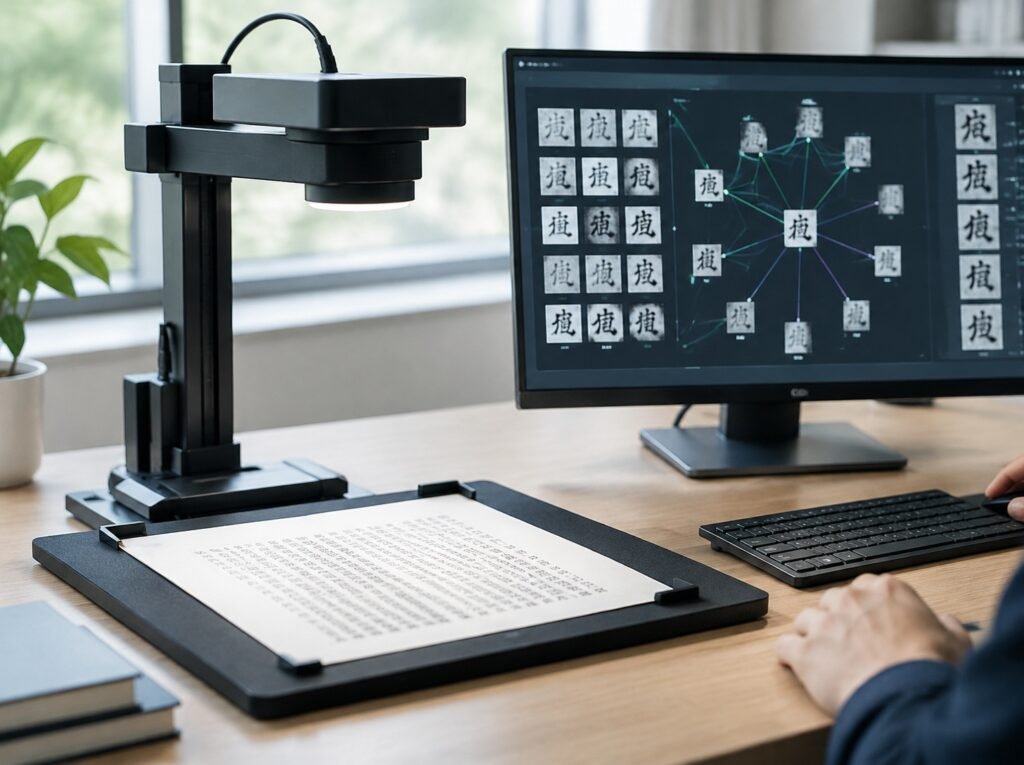
Chinese text recognition is one of the more demanding challenges in artificial intelligence. Unlike English, which uses a relatively small alphabet, Chinese writing contains thousands of characters, many of which look remarkably similar. Even a small difference in strokes can completely change a character’s meaning.
This is where DECTR (Deep Exemplar-Based Chinese Text Recognizer) comes into the picture.
DECTR is an AI-based framework designed to improve Chinese text recognition in images and documents. Instead of relying entirely on conventional character classification, it identifies character examples and retrieves visually similar examples from a reference database. This approach provides additional visual information that can help distinguish difficult characters and correct potential recognition errors.
Introduced in the research paper An Exemplar-based Framework for Chinese Text Recognition at the AAAI Conference on Artificial Intelligence in 2025, DECTR presents an interesting approach to combining character discovery with exemplar retrieval.
In this guide, we explore what DECTR means, how it works, its main components, practical applications, advantages, limitations, and potential role in the future of artificial intelligence.
1. What Is DECTR?
DECTR stands for Deep Exemplar-Based Chinese Text Recognizer. It is a deep learning framework developed to recognise Chinese text in natural scene images and document images.
The framework was introduced by researchers Zhao Zhou, Xiangcheng Du, Yingbin Zheng, Xingjiao Wu, and Cheng Jin.
The main idea behind DECTR is straightforward: instead of asking an AI model to identify every character using classification alone, the system discovers character examples and compares them with previously stored examples.
An exemplar represents a visual example of a character that the model can use during the recognition process.
This retrieval-based approach provides additional visual information that can help distinguish between characters with similar appearances.
For example, imagine a photograph containing a Chinese street sign. The image may be slightly blurred, and two characters may have almost identical shapes. A conventional recognition system might confuse them. DECTR can compare the detected character with examples in its reference database to help identify the more likely character.
In simple terms, DECTR is an AI-powered Chinese text recognition framework that combines deep learning, character discovery, and visual example retrieval to support more accurate recognition.
It is particularly relevant to computer vision, document analysis, optical character recognition (OCR), and intelligent information processing.
2. How Does DECTR Work?
DECTR follows a discovery-and-retrieval approach. Rather than depending on a single recognition operation, it combines multiple stages to identify Chinese characters.
Understanding these stages makes it easier to see why the framework differs from conventional OCR approaches.
Step 1: Identifying Character Examples
The first stage involves finding potential character regions within an image containing a line of Chinese text.
DECTR uses an Exemplar Discovery Network (EDN) to analyse the text line and identify individual character examples, also known as exemplars.
The network learns to locate individual character instances while supporting text recognition.
One important aspect of this approach is weak supervision. The network can learn to discover individual character positions using text-line-level annotations rather than requiring manually prepared character-level bounding boxes for every training example.
This can reduce the annotation effort involved in preparing training data.
Step 2: Creating and Using an Exemplar Database
Once character examples have been identified, the system uses an exemplar database as a reference.
This database stores visual representations of character examples alongside their corresponding labels.
When the model encounters an unfamiliar or difficult character, it can compare its visual representation with examples already stored in the database.
For instance, if two Chinese characters have similar overall structures, their visual representations may still contain subtle differences. Comparing those representations can help the system identify the correct character.
Step 3: Retrieving Similar Characters
The next stage involves retrieving the most relevant examples from the exemplar database.
DECTR compares newly discovered character examples with stored examples to identify visually similar matches.
The retrieved information can then help determine the character’s label and correct potential recognition mistakes.
This is particularly useful when dealing with characters that have similar strokes, complex structures, or unusual visual appearances.
Step 4: Improving the Final Recognition Result
The final stage combines information obtained during character discovery and exemplar retrieval.
Instead of relying exclusively on the model’s initial prediction, DECTR uses additional visual evidence from the retrieved examples.
This helps improve recognition decisions, especially in challenging Chinese text recognition scenarios.
The overall process can be summarised as:
Text image → Character discovery → Exemplar representation → Similarity retrieval → Character recognition and correction.
3. What Are the Main Components of DECTR?
DECTR brings together several components that work as part of one recognition framework. Each component has a specific responsibility.
Exemplar Discovery Network (EDN)
The Exemplar Discovery Network is responsible for identifying character examples within text-line images.
It analyses visual information and learns to locate individual character instances while supporting text recognition.
The use of weak supervision is an important feature because it reduces the need for detailed character-level position annotations during training.
This makes the discovery process more practical for datasets where detailed character annotations are expensive or difficult to obtain.
Exemplar Bank
The Exemplar Bank is the reference database used to store character examples and their associated labels.
It allows the recognition framework to compare newly discovered characters with existing visual examples.
The quality and coverage of this database matter. If the stored examples represent a wide range of character appearances, the retrieval process has more useful information available.
Exemplar Retrieval Module
The Exemplar Retrieval Module searches the database for examples that closely resemble the character being recognised.
Its purpose is to provide additional evidence when the initial recognition result is uncertain or incorrect.
By using visual similarity and retrieved character information, this module helps the framework distinguish between characters that might otherwise be confused.
Together, these three components create the foundation of DECTR’s discovery-and-retrieval architecture.
4. What Are the Main Benefits of DECTR?
DECTR introduces several useful ideas for improving Chinese text recognition. Its benefits are particularly relevant to applications involving complex characters and challenging image conditions.
Better Recognition of Similar-Looking Characters
One of the biggest difficulties in Chinese OCR is distinguishing between characters that have nearly identical visual structures.
A small difference in stroke placement, shape, or composition can change the meaning of a character.
DECTR addresses this challenge by comparing detected character examples with visually similar examples in its database.
This provides additional information that can support more reliable recognition.
Reduced Dependence on Detailed Annotations
Preparing training datasets for character recognition can require considerable manual effort.
Traditional approaches may depend on detailed character-level annotations, including the exact positions of individual characters.
DECTR uses text-line-level annotations to support exemplar discovery through weak supervision.
This can make the training-data preparation process less demanding.
Improved Error Correction
A recognition model can sometimes produce an incorrect prediction because of poor image quality, unusual fonts, or visually similar characters.
DECTR introduces retrieval as an additional source of evidence.
By finding similar examples and using their labels, the framework can help correct potential recognition errors.
However, retrieval should not be treated as a guarantee of perfect recognition. Its effectiveness still depends on the quality of visual features and the reference database.
Support for Different Chinese Text Environments
Chinese text appears in many different forms, including printed documents, handwriting, websites, signs, and everyday photographs.
A recognition framework must deal with changes in fonts, character styles, image quality, and background conditions.
DECTR was evaluated across four Chinese text scenarios: scene, web, document, and handwriting.
This makes its research particularly relevant to systems that need to process different types of Chinese text rather than focusing on a single controlled environment.
5. Where Can DECTR Be Used?
DECTR is a research framework rather than a general-purpose consumer OCR application. Nevertheless, its approach has potential relevance to several practical fields.
Document Digitisation
Businesses, educational institutions, libraries, and public organisations often need to convert printed documents into searchable digital text.
Chinese documents can contain complex characters, specialised terminology, and different printing styles.
A framework such as DECTR could support document-processing systems by helping improve the recognition of difficult characters.
Street Sign and Scene Text Recognition
Text recognition is not limited to scanned documents.
Cameras and mobile devices regularly capture Chinese text in outdoor environments, including street signs, shop names, advertisements, and public information boards.
These images may contain shadows, uneven lighting, perspective distortion, and unusual fonts.
DECTR’s exemplar-based approach is relevant to research into recognising text under such conditions.
Handwriting Recognition
Handwritten Chinese characters can vary significantly between individuals.
Even when two people write the same character, their stroke shapes, spacing, and proportions may be quite different.
Comparing discovered character examples with stored references provides a potential way to address some of these visual differences.
Digital Archives and Historical Records
Libraries and research organisations often work with large collections of historical documents.
Some records contain uncommon characters, faded writing, and inconsistent handwriting styles.
Although DECTR is not specifically designed as a complete historical-document recognition solution, its retrieval-based approach offers useful ideas for developing more capable document analysis systems.
Intelligent Information Processing
Recognising Chinese text is often only the first step in a larger workflow.
After extracting text from an image, an application might organise records, search documents, classify information, or make content available for further analysis.
Improved character recognition can support the reliability of these downstream tasks.
6. DECTR vs. Traditional OCR: What Makes It Different?
Traditional Optical Character Recognition (OCR) systems convert text images into machine-readable characters. They typically use image processing and deep learning techniques to detect and recognise text.
DECTR builds on this general recognition objective but introduces a different approach to character identification.
The main difference is its use of exemplar retrieval as part of the recognition process.
| Feature | Traditional OCR | DECTR |
|---|---|---|
| Main approach | Text detection and recognition | Character discovery and exemplar retrieval |
| Character identification | Model-based prediction | Prediction supported by similar stored examples |
| Reference database | Not necessarily required | Uses an exemplar bank |
| Error correction | Depends on the OCR architecture | Uses retrieved visual examples to support correction |
| Primary research focus | General text recognition | Chinese text recognition |
It is important to understand that DECTR is not a replacement for every existing OCR system. Different OCR architectures are designed for different requirements, languages, and operating environments.
Its main contribution is demonstrating how retrieval-based information can complement deep learning for Chinese text recognition.
7. What Are the Limitations and Challenges of DECTR?
Although DECTR offers an interesting direction for AI-based text recognition, it is important to consider its practical limitations.
Dependence on the Exemplar Database
The quality of retrieval depends partly on the examples stored in the database.
If the database does not contain sufficiently representative character examples, the system may struggle to identify unusual characters or unfamiliar writing styles.
A diverse and well-maintained exemplar bank is therefore important.
Visually Complex Characters
Chinese characters can contain many strokes and intricate structures. In low-resolution images, some of these details may disappear.
Even a sophisticated recognition model can struggle when the original image does not contain enough visual information.
Computational Requirements
DECTR introduces an additional retrieval stage, which requires computational resources.
The system must extract useful character representations, search for relevant examples, and process the retrieved information.
The overall efficiency depends on implementation choices, database size, hardware, and retrieval methods.
Generalisation to New Environments
A recognition system trained and evaluated on particular datasets may not perform equally well in every real-world application.
For example, historical manuscripts, heavily damaged documents, decorative fonts, and unusual handwriting may introduce challenges beyond those represented in standard evaluation datasets.
Consequently, organisations considering DECTR-inspired solutions should test them using data that reflects their actual requirements.
Frequently Asked Questions About DECTR
1. What does DECTR stand for?
DECTR stands for Deep Exemplar-Based Chinese Text Recognizer. It is an AI-based framework that recognises Chinese characters by combining character discovery with visual similarity retrieval from an exemplar database.
2. Is DECTR an OCR technology?
Yes. DECTR is a framework for Chinese text recognition and is relevant to optical character recognition research. It uses deep learning and exemplar retrieval to improve how Chinese characters are identified in images and documents.
3. How does DECTR improve Chinese text recognition?
DECTR identifies character examples within text lines and compares their visual representations with stored examples. The retrieved character information provides additional evidence that can help correct recognition errors, particularly when characters have similar appearances.
4. Who developed DECTR?
DECTR was introduced by Zhao Zhou, Xiangcheng Du, Yingbin Zheng, Xingjiao Wu, and Cheng Jin in the research paper An Exemplar-based Framework for Chinese Text Recognition, published in the Proceedings of the AAAI Conference on Artificial Intelligence in 2025.
5. Can DECTR recognise handwritten Chinese text?
DECTR was evaluated on handwritten Chinese text alongside scene, web, and document text scenarios. Its research therefore demonstrates relevance to handwriting recognition, although performance can vary depending on handwriting style, image quality, and the evaluation dataset.
Conclusion: Why DECTR Matters for the Future of Chinese Text Recognition
DECTR represents an interesting development in artificial intelligence and computer vision. By combining deep learning with exemplar-based retrieval, it offers a different way to approach the challenges of recognising complex Chinese characters.
Its three main components—the Exemplar Discovery Network, Exemplar Bank, and Exemplar Retrieval Module—work together to identify character examples and use visual similarities to support more accurate recognition.
The framework is particularly relevant to document digitisation, scene text recognition, handwriting analysis, and intelligent information processing.
However, its effectiveness depends on factors such as database quality, image conditions, and computational resources. It should be viewed as a research approach rather than a universal solution to every OCR challenge.
As AI research continues to explore more effective ways of understanding visual information, DECTR provides a useful example of how combining recognition with retrieval can address difficult language-processing problems.
If you are exploring modern OCR technologies or researching AI-powered document processing, DECTR is worth understanding. Start by reading the original AAAI 2025 research paper to explore its architecture, methodology, and experimental findings in greater detail.