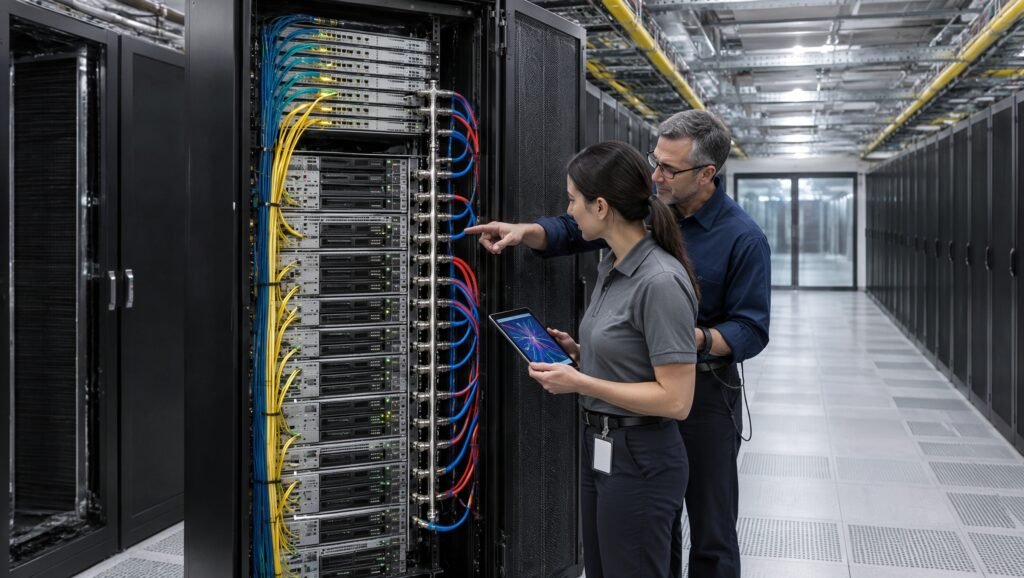
Artificial intelligence is changing the way businesses manage data, develop applications and deliver digital services. From generative AI platforms and machine learning models to autonomous systems and real-time analytics, modern AI workloads require significantly more computing power than traditional business applications. However, this growing demand creates a major infrastructure challenge. Businesses need reliable power, advanced cooling, high-performance connectivity and scalable data centre environments to support increasingly complex AI operations.
This is where Colocation Support AI Infrastructure becomes increasingly important. Colocation allows organisations to deploy their IT equipment within professionally managed data centres rather than building and maintaining their own facilities. When combined with infrastructure designed for artificial intelligence, it provides access to the physical resources and operational expertise needed to support demanding AI workloads.
For businesses exploring AI adoption, choosing the right colocation environment can influence performance, operational costs, scalability and long-term infrastructure planning. Understanding how colocation supports AI systems helps organisations make better decisions about where and how to run their workloads.
What Is Colocation Support for AI Infrastructure?
Colocation support for AI infrastructure refers to the data centre facilities, technical services and operational resources that enable organisations to deploy and operate AI hardware in a professionally managed environment.
Instead of investing in their own buildings, electrical systems, cooling equipment and physical security, businesses rent space within an existing data centre. They retain control over their servers, GPUs, storage systems and software, while the colocation provider manages essential facility infrastructure.
Traditional colocation services were primarily designed for conventional enterprise servers and networking equipment. However, AI applications introduce different requirements, particularly around computing density, electricity consumption, cooling capacity and data movement.
Modern AI infrastructure may include:
- GPU servers: High-performance processors designed to handle parallel computing tasks required by AI training and inference.
- High-speed networking: Low-latency connections that allow multiple servers and accelerators to exchange large volumes of data.
- High-performance storage: Systems capable of delivering datasets quickly without creating bottlenecks during AI operations.
- Advanced cooling: Liquid cooling and other specialised thermal management solutions for high-density computing environments.
- Reliable power infrastructure: Redundant electrical systems that maintain consistent power delivery to critical equipment.
For example, a company developing a generative AI application may need several GPU servers operating together. Rather than constructing a dedicated facility, it can deploy its equipment in a colocation data centre with sufficient power density, cooling and network capacity.
This approach allows the organisation to concentrate on developing and improving its AI technology while relying on specialist infrastructure operators for essential facility support.
Why AI Workloads Require Specialised Colocation Infrastructure
AI workloads place different demands on data centres compared with conventional business applications. Training large machine learning models, processing extensive datasets and delivering real-time AI responses require substantial computing resources.
A standard data centre environment may not provide the capacity needed to support these workloads efficiently.
1. Higher Power Density
AI servers equipped with multiple GPUs can consume considerably more electricity than conventional enterprise servers. When hundreds of these systems operate within a limited space, the electrical demand increases significantly.
Data centre operators must therefore consider power availability at both rack and facility levels.
Businesses evaluating colocation services should examine:
- Available power capacity per rack.
- Electrical distribution infrastructure.
- Backup generators and uninterruptible power supplies.
- Redundant power feeds.
- Future power expansion opportunities.
Power availability is particularly important because a facility may have sufficient overall electrical capacity but lack the distribution infrastructure needed to support high-density AI racks.
Before deployment, organisations should confirm that the provider can accommodate their actual hardware configuration rather than relying on general facility capacity figures.
2. Advanced Cooling Requirements
Heat management is another major challenge associated with AI infrastructure.
High-performance GPUs generate substantial heat during intensive computing operations. If cooling systems cannot remove that heat effectively, hardware may reduce its operating performance, experience thermal stress or become unstable.
Traditional air cooling can support many conventional workloads, but high-density AI environments may require more advanced solutions.
Common cooling technologies include:
- Direct-to-chip liquid cooling: Circulates coolant through cold plates attached to heat-generating components.
- Rear-door heat exchangers: Remove heat from server exhaust using liquid-cooled systems installed at the rear of racks.
- Immersion cooling: Places compatible computing equipment in a specialised dielectric fluid that absorbs heat.
- High-efficiency air cooling: Uses carefully designed airflow and cooling systems to manage thermal conditions.
Not every AI deployment requires liquid cooling. The appropriate solution depends on server specifications, rack density, equipment compatibility and the facility’s cooling design.
Businesses should evaluate cooling capabilities before selecting a colocation provider, particularly when deploying high-performance GPU clusters.
3. High-Speed Network Connectivity
AI systems frequently move large datasets between storage platforms, computing servers and external applications.
During model training, multiple GPUs may need to exchange information continuously. Network congestion or excessive latency can reduce overall computing efficiency.
Colocation facilities can address these requirements through high-speed networking infrastructure, diverse carrier connections and direct connectivity options.
For organisations operating across multiple cloud platforms, direct network connections can also help establish more predictable communication between their infrastructure and external services.
The important consideration is not simply available bandwidth. Network architecture, latency, redundancy and traffic management also influence AI performance.
How Colocation Supports AI Development and Deployment
Colocation provides more than physical space for servers. It offers an operational environment that helps businesses deploy, manage and expand AI systems without taking responsibility for every aspect of data centre construction.
Supporting AI Model Training
Training AI models involves processing large datasets through computationally intensive operations. Depending on the model, this process may require multiple GPU servers working together.
A suitable colocation environment provides the power, cooling and networking capabilities needed to operate these systems.
For example, an AI research company training a large language model may deploy a GPU cluster within a specialised facility. The colocation provider supplies the supporting infrastructure, while the company manages the computing hardware, training software and datasets.
This arrangement can reduce the operational complexity of establishing a dedicated data centre.
Enabling AI Inference at Scale
AI inference occurs when a trained model processes new information to generate predictions, recommendations or responses.
Unlike training, which may involve intensive computing over extended periods, inference workloads often require consistent performance and low response times.
Consider an online retailer using AI to generate product recommendations. Its infrastructure must process customer activity and deliver responses without introducing unnecessary delays.
Colocation can support these applications through reliable computing environments, network connectivity and geographically distributed facilities.
However, organisations with strict latency requirements should carefully evaluate the physical distance between their infrastructure and end users.
Supporting Hybrid Cloud Environments
Many businesses use a combination of public cloud services, private infrastructure and on-premises systems.
Colocation provides another option within this environment.
An organisation might maintain sensitive databases in a private infrastructure environment, use public cloud platforms for selected AI services and operate dedicated GPU clusters within a colocation facility.
This approach provides greater flexibility when allocating workloads according to performance, security, cost and regulatory requirements.
It also allows businesses to avoid depending entirely on a single infrastructure model.
Key Benefits of Colocation Support AI Infrastructure
Choosing a suitable colocation environment can provide several operational and financial advantages for organisations investing in artificial intelligence.
Improved Infrastructure Scalability
AI requirements rarely remain constant. A business may begin with a small GPU deployment and gradually expand its computing capacity as applications attract more users.
Colocation makes it possible to increase infrastructure capacity without constructing an entirely new data centre.
However, scalability depends on available power, cooling capacity, physical space and network resources. Businesses should confirm expansion availability before committing to a long-term agreement.
Reduced Capital Investment
Building a dedicated AI data centre requires substantial investment in land, construction, electrical systems, cooling infrastructure and security.
Colocation provides access to an existing facility through a service agreement.
This can reduce the initial capital expenditure associated with infrastructure deployment. Instead of financing an entire building, businesses pay for the capacity and services they require.
Nevertheless, colocation is not automatically cheaper than owning infrastructure. Long-term rental charges, electricity costs, cross-connect fees and additional support services must all be considered.
A detailed total cost of ownership comparison is essential before making a decision.
Greater Operational Reliability
Professional data centre operators typically maintain redundant power systems, environmental monitoring, physical security and operational procedures.
These capabilities help protect critical infrastructure against facility-related disruptions.
Businesses should review the provider’s service-level agreements, maintenance procedures, incident response arrangements and historical availability information.
It is also important to distinguish between facility uptime and application availability. A reliable data centre cannot independently guarantee that an organisation’s AI application will remain operational if its software, networking or hardware architecture has weaknesses.
Better Access to Technical Expertise
Managing high-density AI infrastructure requires specialised knowledge of power distribution, thermal management, networking and hardware deployment.
Colocation providers can offer facility engineering, remote hands and technical support services.
These services can help organisations handle physical maintenance and infrastructure-related issues without maintaining a large on-site facilities team.
The exact level of assistance varies between providers, so businesses should establish which services are included in their contracts.
How to Choose the Right AI Colocation Provider
Selecting a colocation provider requires more than comparing rack prices or data centre locations. Organisations need to evaluate whether a facility can support their specific AI hardware and operational requirements.
The following factors deserve particular attention.
Power and Cooling Capacity
Start by reviewing the facility’s available power capacity and its ability to support high-density GPU deployments.
Ask providers about rack-level power limits, cooling technologies, redundancy arrangements and future expansion capacity.
Request technical specifications that match the intended server configuration.
Network Infrastructure
Evaluate available carriers, internet connectivity, cross-connect options and network redundancy.
For distributed AI systems, reliable communication between computing clusters and storage environments is particularly important.
Businesses should also consider network latency when selecting a facility location.
Physical Security and Compliance
AI infrastructure may process confidential business information, customer records or commercially sensitive datasets.
A suitable colocation facility should provide controlled physical access, surveillance, environmental monitoring and documented security procedures.
Depending on the industry and deployment location, organisations may also need to consider relevant regulatory obligations and independently verified certifications.
Importantly, using a certified data centre does not automatically make every customer workload compliant. Businesses remain responsible for their own applications, data governance and security controls.
Service-Level Agreements
A service-level agreement (SLA) defines the provider’s contractual responsibilities and performance commitments.
Review the SLA carefully to understand:
- Power availability commitments.
- Cooling and environmental responsibilities.
- Network service arrangements.
- Maintenance notification procedures.
- Incident response expectations.
- Service credits and contractual limitations.
A clear agreement helps establish accountability and reduces misunderstandings during infrastructure operations.
Common Challenges and Considerations
Although colocation offers important advantages, it is not a universal solution for every AI deployment.
One challenge is power availability. Demand for high-density computing can make suitable electrical capacity difficult to secure, particularly in established data centre markets.
Cooling requirements can also increase deployment complexity. Some facilities may require equipment modifications or specialised cooling arrangements before accepting advanced GPU systems.
Another consideration is physical distance. Organisations operating latency-sensitive applications should evaluate whether a particular data centre location provides sufficiently fast access to users, cloud services and connected systems.
Cost management also requires attention. Electricity consumption, cooling-related charges, bandwidth, remote support and additional connectivity can increase the total monthly expense.
Finally, businesses should understand the division of responsibility between themselves and the colocation provider. The provider generally manages the physical facility, while customers remain responsible for their servers, operating systems, applications and many aspects of cybersecurity.
Careful planning, technical assessments and transparent contractual arrangements can help reduce these challenges.
The Future of Colocation Support for AI Infrastructure
The continued development of artificial intelligence is increasing demand for data centre infrastructure capable of supporting more powerful and complex computing systems.
Several developments are likely to influence the future of AI colocation.
First, higher-density computing will encourage further investment in advanced cooling technologies. Liquid cooling is becoming increasingly important for facilities designed to accommodate demanding GPU deployments.
Second, energy efficiency will receive greater attention. Data centre operators will need to balance computing performance with electricity consumption, cooling efficiency and environmental considerations.
Third, networking infrastructure will continue to evolve. Faster interconnects and improved network architectures will help support communication between distributed AI systems.
Finally, the relationship between colocation and cloud computing will become increasingly important. Businesses will continue exploring hybrid environments that combine dedicated hardware, cloud services and specialised AI infrastructure.
These developments suggest that colocation will remain an important infrastructure option for organisations seeking greater control over their AI computing environments.
Frequently Asked Questions
What is colocation in AI infrastructure?
Colocation in AI infrastructure involves hosting privately owned computing equipment within a professionally managed data centre. Businesses retain control of their servers and AI applications while using the facility’s power, cooling, security and connectivity services.
Why do AI workloads need specialised colocation facilities?
AI workloads often require high-density GPU servers, substantial electrical capacity, advanced cooling and high-speed networking. Specialised colocation facilities are designed to accommodate these requirements more effectively than conventional server environments.
Is colocation better than cloud computing for AI?
Neither option is universally better. Colocation can provide greater control over dedicated hardware and may offer cost advantages for sustained, predictable workloads. Cloud computing provides flexible access to resources without requiring businesses to manage physical hardware. Many organisations use a combination of both.
How much power does an AI colocation rack require?
Power requirements depend on the number of servers, GPU specifications and overall rack configuration. Some conventional racks operate at relatively modest power densities, while specialised AI deployments can require tens of kilowatts or more per rack. Businesses should calculate actual equipment requirements before selecting a facility.
What should businesses look for in an AI colocation provider?
Businesses should evaluate power capacity, cooling technology, network connectivity, physical security, scalability, technical support and service-level agreements. The provider must demonstrate that its facility can accommodate the organisation’s specific AI hardware and operational requirements.
Conclusion
Artificial intelligence is creating new infrastructure demands that conventional data centre environments may struggle to accommodate. High-performance computing, GPU-intensive workloads, advanced cooling and reliable connectivity have become essential considerations for organisations developing and deploying AI applications.
Colocation Support AI Infrastructure offers a practical approach by providing access to professionally managed data centre facilities without requiring businesses to build and operate their own infrastructure. It can support AI training, inference, hybrid cloud deployments and future computing expansion.
However, the right solution depends on workload requirements, infrastructure costs, power availability and long-term business objectives.
Before choosing a provider, assess your expected computing capacity, cooling requirements, network performance and scalability needs. A well-planned colocation strategy can help establish a reliable foundation for AI development while giving your organisation greater flexibility as technology and business demands evolve.