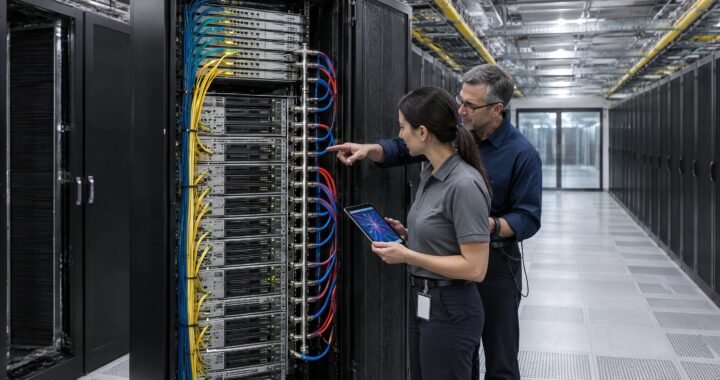
Artificial intelligence is changing how businesses build applications, manage data, and deliver digital services. However, as AI systems become more powerful, organizations are discovering that computing performance depends on more than advanced models and expensive hardware. Where AI workloads run, how quickly they access data, and how efficiently they communicate with cloud infrastructure can make a significant difference.
This is where AI Cloud Adjacency becomes increasingly important.
AI Cloud Adjacency describes the strategic positioning of AI computing resources, data, applications, and supporting infrastructure close to cloud environments and the services they depend on. The goal is to reduce unnecessary data movement, improve connectivity, support faster processing, and create a more efficient environment for modern AI workloads.
As businesses adopt generative AI, machine learning, automation, and real-time analytics, infrastructure decisions are becoming more important than ever. Traditional cloud computing remains essential, but organizations increasingly need flexible architectures that bring computing closer to their data, applications, and users.
In this guide, we explore what AI Cloud Adjacency means, why it matters, how it works, its major benefits, and what businesses should consider when adopting this approach.
What Is AI Cloud Adjacency?
AI Cloud Adjacency refers to an infrastructure strategy that places AI workloads, computing resources, storage systems, and network connections near cloud platforms, data sources, or other services they frequently use.
In simple terms, it means reducing the distance between AI applications and the resources they need to operate efficiently.
For example, imagine a company running an AI-powered customer support application. The application needs access to customer records, language models, databases, and cloud-based services. If these resources are spread across distant environments, information may need to travel through several network connections before the application can produce a response.
An adjacency-focused architecture aims to position these resources closer together, reducing unnecessary communication delays and simplifying data access.
How Does AI Cloud Adjacency Work?
AI Cloud Adjacency combines several infrastructure components to create a connected computing environment.
These commonly include:
- AI computing infrastructure: CPUs, GPUs, accelerators, and other hardware used to train and run AI models.
- Cloud platforms: Public, private, or hybrid cloud environments that provide computing, storage, networking, and managed services.
- Data infrastructure: Databases, data lakes, storage systems, and processing platforms that supply information to AI applications.
- Network connectivity: High-performance connections that allow applications and infrastructure to exchange information efficiently.
- Edge computing: Local computing resources that process information closer to where it is generated or consumed.
- Security and management systems: Tools that control access, protect information, and maintain operational consistency.
The exact architecture depends on the workload. Some applications benefit from placing AI infrastructure near a cloud region, while others require processing directly inside a business facility or at an edge location.
The important principle is that infrastructure placement should support the application’s actual performance, security, and business requirements.
Why AI Cloud Adjacency Matters Now
AI adoption is increasing, but scaling AI applications introduces challenges that traditional infrastructure strategies do not always address effectively.
Large language models, computer vision systems, recommendation engines, and real-time analytics applications can generate substantial computing and networking demands.
Organizations must consider not only how much processing power they have but also how efficiently their systems can access information.
Here are some reasons AI Cloud Adjacency is becoming increasingly relevant.
1. AI Workloads Require Faster Data Access
AI applications depend on data. Whether an organization is training a machine learning model or running an AI-powered application, information must move between storage, computing resources, and software services.
When these resources are located far apart, data transfer can introduce additional latency and network overhead.
Placing frequently used data and computing resources closer together can reduce unnecessary movement and improve application responsiveness.
For example, a financial services company analyzing transactions in real time may need to process large volumes of information quickly. A well-planned infrastructure can keep relevant computing and data resources within an efficient network environment.
This does not mean physical proximity automatically guarantees better performance. Network quality, storage architecture, processing capacity, and application design also matter.
2. It Helps Reduce Network Bottlenecks
As AI applications grow, networks must handle increasingly complex communication patterns.
AI training may require frequent communication between multiple accelerators, while AI inference applications continuously exchange requests and responses with models, databases, and other services.
Poorly designed network connections can become bottlenecks even when powerful computing hardware is available.
AI Cloud Adjacency encourages organizations to evaluate network architecture alongside computing infrastructure.
A more efficient arrangement can help reduce unnecessary traffic, improve connectivity between dependent systems, and make infrastructure easier to scale.
For businesses operating large AI environments, these improvements can be particularly valuable.
3. It Supports Real-Time AI Applications
Many AI applications need to respond almost immediately.
Examples include industrial monitoring, fraud detection, autonomous systems, intelligent security platforms, and personalized digital services.
Sending every request to a distant cloud environment may introduce delays that affect the user experience or operational performance.
AI Cloud Adjacency supports distributed architectures in which selected processing tasks happen closer to the data source or end user.
For instance, a manufacturing facility can use local AI infrastructure to identify unusual machine behavior without sending every sensor reading to a remote data center first.
The cloud can still handle centralized analytics, model management, long-term storage, and other resource-intensive operations.
This combination creates a practical balance between local responsiveness and centralized computing capabilities.
Key Benefits of AI Cloud Adjacency for Businesses
AI Cloud Adjacency is not simply an infrastructure trend. When implemented correctly, it can support measurable improvements in how organizations operate their AI systems.
Improved Performance and Lower Latency
One of the most important advantages is the potential to reduce communication delays.
When AI workloads are positioned closer to the data and services they depend on, applications may spend less time waiting for information to travel across networks.
This is particularly useful for interactive AI applications, real-time analytics, and systems that require frequent communication between multiple infrastructure components.
However, actual performance improvements depend on network configuration, workload characteristics, and the location of supporting services.
Better Infrastructure Efficiency
AI hardware can be expensive to operate. GPUs, high-performance storage, networking equipment, and data center resources all contribute to infrastructure costs.
An adjacency-focused strategy helps organizations evaluate where computing resources should be located and how they should be used.
For example, businesses can keep frequently accessed data close to AI processing environments instead of repeatedly transferring large datasets across distant networks.
They can also distribute workloads according to available computing capacity rather than relying on a single centralized environment for every task.
This can improve resource utilization and help reduce avoidable infrastructure expenses.
Greater Flexibility Through Hybrid Cloud
Not every AI workload belongs in the same environment.
Some applications require the scalability of public cloud platforms, while others need dedicated infrastructure, local processing, or stricter control over sensitive information.
AI Cloud Adjacency supports a hybrid approach that combines different computing environments.
A business might use:
- Public cloud infrastructure for scalable AI development.
- Private infrastructure for confidential business information.
- Edge computing for applications requiring rapid local responses.
- Centralized cloud services for model management and analytics.
This flexibility allows organizations to select infrastructure based on workload requirements instead of forcing every application into one deployment model.
Stronger Data Control and Security
Data protection is an important consideration when deploying AI systems.
Businesses may handle financial information, customer records, intellectual property, or other sensitive datasets that require strict access controls.
Keeping selected processing activities within controlled infrastructure can help organizations limit unnecessary data transfers and maintain clearer security boundaries.
However, physical proximity alone does not make an AI environment secure.
Organizations still need encryption, identity management, network segmentation, access monitoring, backup strategies, and appropriate governance policies.
AI Cloud Adjacency should therefore be treated as one part of a broader security architecture.
AI Cloud Adjacency vs. Traditional Cloud and Edge Computing
Understanding the difference between AI Cloud Adjacency, traditional cloud computing, and edge computing helps businesses identify where each approach fits.
Traditional cloud computing provides centralized computing, storage, and software services through remote data centers. It offers scalability and access to managed infrastructure without requiring businesses to operate every component themselves.
Edge computing moves selected computing resources closer to devices, users, and data sources. This approach is particularly useful when applications need low latency, local processing, or continued operation during connectivity disruptions.
AI Cloud Adjacency focuses on the strategic relationship between AI workloads and the cloud, data, networking, and computing resources they depend on.
These approaches are not competing technologies. They can work together within a single architecture.
| Technology | Main Focus | Common Use Case |
|---|---|---|
| Traditional cloud computing | Centralized computing and storage | AI development and large-scale data processing |
| Edge computing | Processing close to data sources | Industrial automation and real-time monitoring |
| AI Cloud Adjacency | Efficient positioning and connectivity of AI and cloud resources | Connected AI infrastructure and distributed workloads |
For example, an organization might train its AI models in a centralized cloud environment, deploy inference services at regional locations, and process time-sensitive information through local edge systems.
The result is a distributed architecture that uses each environment where it provides the greatest value.
How to Implement an AI Cloud Adjacency Strategy
Adopting AI Cloud Adjacency requires more than purchasing new hardware or moving applications between data centers.
Organizations should begin by understanding their workloads, infrastructure limitations, and business objectives.
The following steps provide a practical starting point.
1. Evaluate Your Existing AI Workloads
Start by identifying the AI applications your organization currently operates or plans to deploy.
Consider their computing requirements, data sources, network dependencies, and performance expectations.
For each workload, ask:
- How frequently does the application access external data?
- Does it require real-time responses?
- How much computing capacity does it consume?
- Does it process sensitive or regulated information?
- What happens if network connectivity becomes unavailable?
These questions help determine whether a workload should run centrally, locally, or across multiple environments.
2. Assess Network and Infrastructure Requirements
Next, evaluate the connections between AI computing resources, cloud platforms, storage systems, and business applications.
Look for network bottlenecks, unnecessary data transfers, inconsistent connectivity, and infrastructure limitations.
Measure important performance indicators such as latency, throughput, packet loss, and network availability.
It is also important to examine storage performance and accelerator utilization. A faster network will not solve every problem if the actual bottleneck is insufficient memory bandwidth, slow storage, or limited GPU capacity.
3. Choose the Right Cloud and Computing Environment
Select infrastructure according to the needs of each application.
Public cloud platforms may provide the flexibility required for large-scale development and experimentation.
Private infrastructure may be appropriate for sensitive workloads requiring greater operational control.
Edge environments can support applications that depend on local processing and rapid responses.
The objective is not to move everything closer to the cloud. It is to identify the most effective location for each workload.
4. Establish Security and Data Governance
Security should be considered from the beginning rather than added after deployment.
Define who can access AI systems, where sensitive information can be processed, and how data moves between environments.
Use encryption, strong authentication, network segmentation, logging, and continuous monitoring.
Organizations should also review relevant data protection obligations and contractual requirements before choosing infrastructure locations.
5. Monitor Performance and Optimize Continuously
AI infrastructure requirements change as models, applications, and data volumes grow.
Regularly evaluate application response times, network utilization, computing costs, resource availability, and system reliability.
Use these measurements to identify opportunities for improvement.
For example, if a particular application repeatedly transfers large datasets between environments, moving selected processing activities closer to the source may improve efficiency.
An effective AI Cloud Adjacency strategy should evolve alongside business needs.
Real-World Applications of AI Cloud Adjacency
AI Cloud Adjacency can support different industries because organizations increasingly depend on connected data and intelligent applications.
Healthcare: Healthcare organizations can use distributed AI infrastructure to support medical image analysis, operational analytics, and clinical applications. Sensitive information may require carefully controlled processing environments, while centralized cloud resources can support research and broader analytics.
Financial services: Banks and financial institutions can use efficient infrastructure arrangements for fraud detection, risk analysis, and real-time transaction monitoring. Low-latency connectivity and strong security controls are particularly important.
Manufacturing: Industrial businesses can process equipment sensor data through local AI systems while using cloud platforms for centralized reporting, model development, and predictive maintenance.
Retail and e-commerce: Retailers can combine cloud-based analytics with regional or local AI processing to improve product recommendations, inventory forecasting, and customer experiences.
Telecommunications: Telecom operators can distribute AI workloads across network locations to support traffic analysis, intelligent network management, and responsive customer services.
Across these industries, the same principle applies: AI infrastructure should be designed around the location, movement, sensitivity, and processing requirements of business data.
Frequently Asked Questions About AI Cloud Adjacency
What is AI Cloud Adjacency in simple terms?
AI Cloud Adjacency is an infrastructure approach that positions AI computing resources, data, and supporting services close to the cloud environments they depend on. Its purpose is to improve connectivity, reduce unnecessary data movement, and support efficient AI performance.
Why is AI Cloud Adjacency important for businesses?
It helps businesses plan more efficient AI infrastructure. By improving the relationship between computing resources, networks, and data sources, organizations can address latency, infrastructure costs, scalability, and data management challenges.
Is AI Cloud Adjacency the same as edge computing?
No. Edge computing focuses on processing information close to where it is generated or consumed. AI Cloud Adjacency focuses more broadly on the strategic positioning and connectivity of AI workloads and their supporting cloud resources. Both approaches can work together.
Does AI Cloud Adjacency reduce cloud computing costs?
It can help reduce certain expenses by minimizing unnecessary data transfers, improving resource utilization, and supporting more efficient workload placement. However, savings are not guaranteed. Infrastructure costs depend on hardware, connectivity, storage, cloud pricing, and operational requirements.
How can a business get started with AI Cloud Adjacency?
A business can begin by evaluating its AI workloads, measuring network performance, identifying data dependencies, and determining where different applications should run. It should then establish security controls, test the proposed architecture, and monitor performance before expanding deployment.
Conclusion: Building a More Efficient Future With AI Cloud Adjacency
AI Cloud Adjacency is becoming an important consideration as organizations move beyond basic AI experimentation and begin deploying intelligent applications at scale.
The growing demand for faster data access, reliable connectivity, flexible computing, and stronger security makes infrastructure placement a strategic business decision.
By bringing AI workloads closer to the cloud services, data sources, and computing resources they depend on, organizations can build more responsive and efficient systems. Combining cloud platforms, private infrastructure, and edge computing also provides the flexibility needed to support different AI requirements.
However, successful implementation requires careful planning. Businesses should evaluate workload characteristics, network performance, infrastructure costs, and security requirements before making deployment decisions.
The future of AI will not depend on computing power alone. It will also depend on how intelligently organizations connect and position their infrastructure.
If your organization is planning to expand its AI capabilities, start by reviewing your existing cloud architecture and identifying where better connectivity and workload placement could make a meaningful difference. A well-designed foundation today can make future AI growth easier to manage, scale, and sustain.