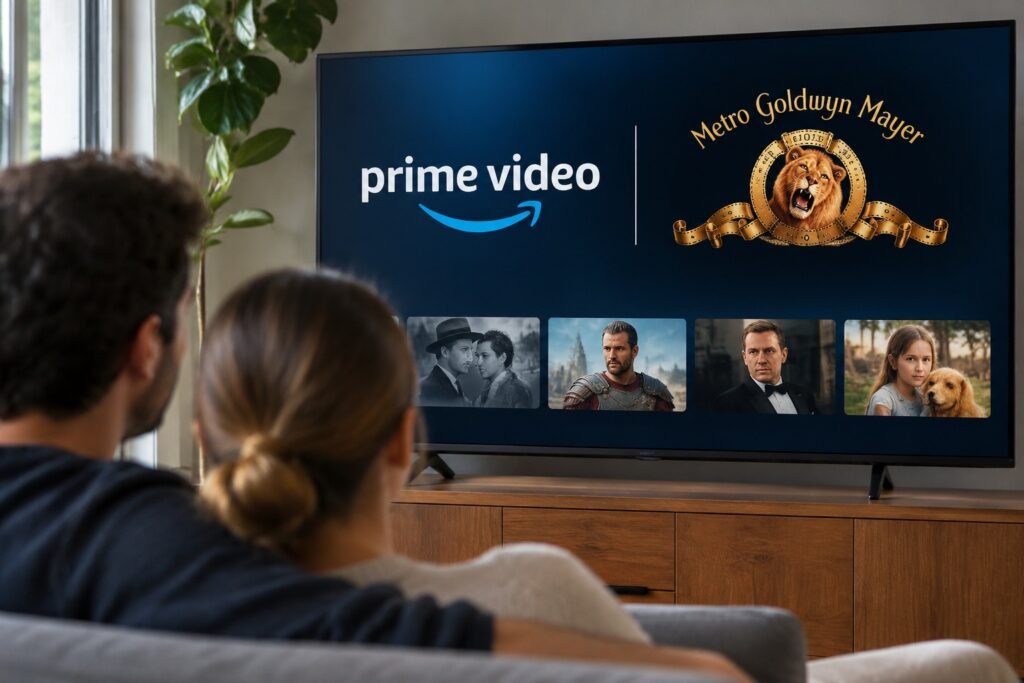
Amazon Prime Video has introduced AI-assisted video enhancement for more than 60 MGM films and television series that were previously available only in standard definition (SD). Announced on 25 November 2026, the upgrade converts selected older titles into high-definition (HD) versions through a combination of artificial intelligence, image processing and human quality control. The initial selection includes the film Stolen Hours and episodes of the 1950s television series Highway Patrol. Amazon says the enhanced titles are available to Prime Video customers worldwide.
Key takeaways
- Prime Video has upgraded more than 60 previously SD-only MGM movies and series to HD using AI-assisted technology.
- The four-stage process combines image cleanup, two AI upscaling operations, preservation of the original appearance and film grain refinement.
- Human video specialists review every enhanced title, with Amazon planning to bring more older productions to HD in 2027.
How Prime Video AI upscaling works
The new Prime Video AI upscaling system uses several artificial intelligence models trained on Amazon Web Services (AWS). Rather than relying on a single image-enhancement operation, the technology divides the work into four stages, with each stage addressing a different aspect of the original footage.
According to Amazon’s official announcement, engineers and video specialists helped develop the system to improve picture clarity while maintaining the original visual identity of each production.
1. Cleaning up older footage
The first stage removes common visual imperfections found in older video material. Older recordings and digital copies can contain visible defects that become more noticeable when displayed on modern televisions and monitors.
The cleanup process prepares the footage for subsequent enhancement operations. Amazon has not published a complete technical list of the defects its system can identify or the specific algorithms used to remove them.
2. AI-powered image upscaling
The second stage uses two separate AI models to improve image definition. The first model sharpens the original low-resolution image, while the second refines textures and smaller visual details.
Upscaling means increasing an image’s resolution so that it can be displayed at a higher pixel count. Traditional upscaling techniques can enlarge images through interpolation, which estimates the values of additional pixels based on neighbouring ones.
AI-based methods can go further by using learned image patterns to refine edges and textures. However, the resulting detail is partly reconstructed by the model rather than necessarily recovered from the original camera negative or film print.
Amazon has not disclosed the models’ names, architecture, training datasets or exact technical specifications. It has also not published independent image-quality measurements comparing the original SD versions with the enhanced HD releases.
3. Preserving the original visual appearance
One challenge with enhancing older entertainment content is maintaining its original artistic identity. Excessive sharpening, noise removal or colour adjustment can make historical footage look noticeably different from its original presentation.
Prime Video says its technology maintains the original style and colour of each title. This matters because older films and television programmes were produced using different cameras, film stocks, lighting techniques and production standards.
The objective is to improve visibility without unnecessarily changing the appearance that audiences associate with the original production. Amazon has not published a detailed set of preservation parameters or a title-by-title restoration methodology.
4. Adding film grain back into the image
The final stage incorporates natural film grain, adjusted using feedback from studio experts. Film grain refers to the visible texture created by the light-sensitive particles in traditional photographic film.
This texture is an important characteristic of many older movies. Removing too much grain during digital enhancement can produce an unusually smooth appearance that may look artificial, particularly on large modern displays.
Prime Video’s approach attempts to retain this characteristic after processing. However, Amazon has not explained whether the grain is retained directly from the source material, reconstructed or recreated through a combination of techniques.
Why Prime Video is upgrading classic MGM movies
Standard-definition video was designed around the display technology available when many older television programmes and films were originally produced. Its lower resolution can appear noticeably less detailed when enlarged across modern television screens.
For viewers watching older productions on large 4K televisions, the difference between an SD source and a well-processed HD version can be particularly noticeable. Soft edges, limited detail and compression artefacts can make older content less comfortable to watch.
MGM’s extensive film and television library provides an opportunity to apply this technology to entertainment that already has an established audience. Instead of producing entirely new versions of these programmes, Amazon is improving selected existing digital material.
The first announced selection contains more than 60 titles, including Stolen Hours and episodes of Highway Patrol. Amazon has not published a complete catalogue of upgraded productions, so viewers cannot yet use the announcement to identify every available title.
The company has also confirmed that additional titles are planned for 2027, although it has not provided a specific release schedule or the number of productions expected in the next batch.
AI enhancement versus traditional film restoration
The Prime Video announcement raises an important distinction between AI upscaling and traditional film restoration. Although both approaches can improve the appearance of older entertainment, they do not necessarily use the same source materials or recover the same information.
Traditional film restoration can involve locating original negatives, archival prints or other surviving production elements. Specialists then scan the selected material at high resolution and perform careful digital corrections to preserve its historical and visual characteristics.
AI upscaling generally starts with an existing digital image or video copy. The technology estimates and refines visual information to produce a higher-resolution output. This can improve presentation, but it does not automatically recover details that were never captured in the digital source.
The International Federation of Film Archives’ digital restoration guidance emphasises the importance of preserving original characteristics, including colour, frame rate, aspect ratio and historically relevant visual details.
This distinction matters when evaluating Amazon’s announcement. The company describes its process as AI-assisted enhancement that upgrades SD material to HD. It has not announced a complete re-scanning of original film negatives or claimed that the selected productions have undergone conventional archival restoration.
For viewers, an enhanced HD version may look considerably clearer than its previous streaming copy. However, that improvement should not automatically be interpreted as evidence that the new version contains all the original visual information.
Can AI enhancement change the original cinematic quality?
AI-assisted enhancement creates opportunities to improve older entertainment, but it also introduces questions about visual accuracy.
An AI model may interpret an unclear texture as a particular surface, refine an edge that was previously indistinct or remove imperfections that were actually part of the original image. These changes can improve perceived sharpness while potentially introducing visual differences.
Film grain presents another challenge. Although Amazon says it adds natural film grain back into enhanced footage, the announcement does not explain how the system determines the appropriate grain characteristics for individual productions.
The Society for Imaging Science and Technology’s research on digital film restoration discusses the relationship between restoration, visual authenticity and the preservation of a film’s original appearance.
Human oversight is therefore an important part of Prime Video’s approach. According to Amazon, every enhanced movie and series is reviewed by video specialists before publication. These specialists assess accuracy, consistency and faithfulness to the original production.
However, the company has not published independent assessments or side-by-side technical comparisons that would allow viewers to evaluate the results across all 60-plus titles. The quality of individual enhancements may also depend on the condition and characteristics of their original digital sources.
What the upgrade means for Prime Video subscribers
For everyday viewers, the immediate benefit is access to improved versions of selected older MGM productions without needing to locate separate remastered editions.
Amazon says the enhanced titles are available to Prime Video customers worldwide. In the United States, viewers can identify them through a dedicated homepage carousel labelled “Digitally enhanced to HD”.
The announcement does not confirm that this particular carousel will appear in every country. It also does not provide a country-by-country title list, meaning the exact selection visible to customers may require checking the local Prime Video catalogue.
Amazon has not announced a separate charge for accessing these enhanced versions or disclosed any additional subscription requirements. The announcement also does not specify changes to existing subscription prices.
There is another technical consideration: an HD source does not guarantee that every viewer will receive the same picture quality. Streaming quality can depend on the available title version, device compatibility, internet connection and playback conditions.
For viewers using large televisions, the improvements may be more noticeable than on smaller mobile screens. Nevertheless, the actual difference will depend on the original footage and the quality of the enhancement.
What happens next for AI-powered video restoration?
Amazon’s announcement indicates that AI-assisted enhancement could become a broader part of its content-management strategy. The company has already confirmed plans to upgrade additional older titles during 2027.
The approach also highlights a wider opportunity for streaming platforms with extensive historical libraries. Improving existing digital copies may provide a practical way to make older entertainment more suitable for modern displays without carrying out a complete traditional restoration for every title.
However, the long-term value of this approach will depend on how accurately AI systems handle different production styles and how effectively human specialists identify unwanted changes.
The next developments worth watching include the release of a complete enhanced-title catalogue, more technical information about the AI models and independent comparisons of the resulting picture quality.
For now, Prime Video’s announcement establishes a specific use of AI in entertainment distribution: improving the viewing quality of existing films and television programmes while retaining human review as part of the production process.
Frequently asked questions
1. What is Prime Video AI upscaling?
Prime Video AI upscaling is an AI-assisted technology that improves the picture quality of selected older films and television programmes. It uses image cleanup, two upscaling models, visual preservation techniques and film grain refinement to convert selected SD material into HD versions.
2. How many MGM titles has Amazon upgraded to HD?
Amazon announced that more than 60 MGM movies and television series have received HD upgrades. The initial examples include Stolen Hours and episodes of the 1950s series Highway Patrol.
3. When did Prime Video introduce AI-enhanced movies?
Amazon announced the feature on 25 November 2026. The enhanced titles became available to Prime Video customers from that date.
4. Are AI-enhanced MGM movies available worldwide?
Yes. Amazon says the upgraded titles are available to Prime Video customers worldwide. However, the company has not published a complete country-specific catalogue of the enhanced productions.
5. Does Prime Video AI enhancement produce 4K movies?
Amazon’s announcement specifically describes upgrades from standard definition to high definition. It does not announce 4K restoration or confirm that the enhanced titles are available in native 4K resolution.
6. Does AI upscaling change the original film?
AI upscaling can reconstruct or refine visual details, which may produce differences from the original digital footage. Amazon says its process preserves each title’s original style and colour, with human specialists reviewing the results before publication.
7. Does Prime Video charge extra for AI-enhanced movies?
Amazon has not announced a separate fee or additional subscription requirement for these enhanced titles. They are described as being available to Prime Video customers worldwide.
8. Will Amazon upgrade more classic movies in 2027?
Yes. Amazon has confirmed that it plans to make additional titles available in HD using AI-assisted technology during 2027. It has not yet announced the complete selection or a detailed release timetable.